

Ethos is the world's first app that helps you identify, live by, and grow through your true values.
The result: clarity that doesn't crack, performance that compounds, and relationships that actually last.
The result: clarity that doesn't crack, performance that compounds, and relationships that actually last.
No credit card required • Public app launch Q4 2026
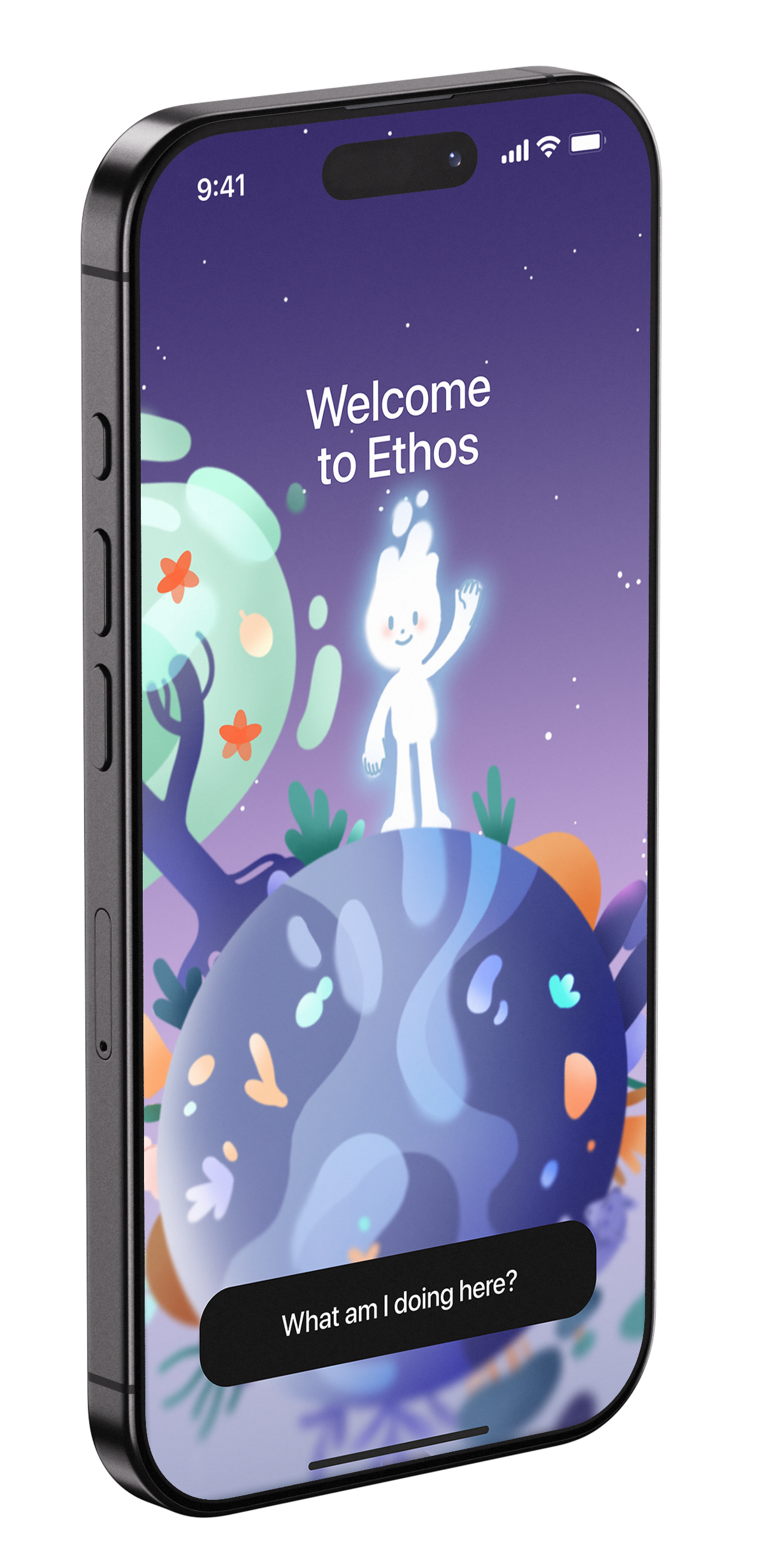
Hey there, I’m Alex!
Your virtual values
alignment buddy :)
Your virtual values
alignment buddy :)
On a mission to reclaim what makes us human.
Well-being, growth & connection in the age of AI.

40 Years of R&D
International Patents
Big Tech Pilot
Big 4 Traction
120+ Companies Waitlisted
1,000+ Beta Users
UNESCO-Recognised Program
40 Years of R&D
International Patents
Big Tech Pilot
Big 4 Traction
120+ Companies Waitlisted
1,000+ Beta Users
UNESCO-Recognised Program
40 Years of R&D
International Patents
Big Tech Pilot
Big 4 Traction
120+ Companies Waitlisted
1,000+ Beta Users
UNESCO-Recognised Program

There is a reason we're experiencing a mental health pandemic.
The world has changed 100,000 times faster than we humans have.
Same brain structure, same nervous system, same biology. Exponentially more noise, pressure, and distraction. The gap between how fast technology moves and how equipped we are to handle it is no longer a wellness issue - it's an existential one.
The solutions on offer - the apps, the therapy, the mindfulness - aren't closing the gap. They're managing it. The root of the problem has never been addressed. Until now.
The solutions on offer - the apps, the therapy, the mindfulness - aren't closing the gap. They're managing it. The root of the problem has never been addressed. Until now.
40%
Drop in in-person connection
Drop in in-person connection
50%
Attention spans have halved
Attention spans have halved
1 in 4
People feel lonely every single day
People feel lonely every single day
Think of it as a gym for the one muscle nobody thinks of training.
Your values are the operating system beneath every decision you make, every relationship you build, every goal you chase. Most people have never stopped to look at them clearly. Ethos changes that.
Through daily practices built on 40 years of validated behavioral science - now gamified, personalized, and available to anyone - Ethos makes the invisible visible.
Through daily practices built on 40 years of validated behavioral science - now gamified, personalized, and available to anyone - Ethos makes the invisible visible.
Name it.
Discover what actually drives you - beneath the noise.
Follow it.
Daily practices that keep your values from staying abstract.
Live it.
Watch what happens when your actions and your values finally agree.
Knowing your true values is the most powerful thing you can do in today's society.
From quitting decades-long smoking habits to saving marriages to overachieving team KPIs - the protocol works across every area of life.
- — Tom, Ex-Executive, Now Founder"I stopped chasing things that weren't mine. That alone changed everything."
- — Sebastian & Léa, Beta Users"We nearly divorced. I can say that now because we didn't."
- — Clara, Creative Director"For the first time, I'm not performing a version of myself at work. I just show up."
- — Kate, Beta User"We are now happier than we've been in years. The kids have started doing it too."
- — Marcus, Product Director"I used to second-guess every decision. Now I just know. It's hard to explain until you feel it."
- — Priya, Head of People, Tech Scale-up"My team went from constant conflict to the most cohesive we've ever been. Same people. Different foundation."
- — Diane, Senior Partner, Professional Services"My daughter said I seem more like myself again. That hit harder than any KPI."
- — Natalie, Beta User"I've been in therapy for six years. This reached something therapy never did."
ETHOS built on 40 years of behavioral science fixes it at the root.
You've optimised your habits, your schedule, your mindset. And still fall back the moment the environment shifts. That's not a willpower problem. That's a values problem.

01
Every decision gets easier - uncertainty dissolves.
02
No algorithm, incentive, or pressure can compromise who you are.
03
Your relationships are built on something real.
04
Performance stops depending on motivation - it runs on alignment.
05
Everything compounds - because the foundation is unshakeable.
Know yourself. Understand each other. Lead with clarity.
Ethos meets you wherever the misalignment lives - in your own head, in your closest relationships, or across an entire team.
Ethos
For you
You've tried the habits. The journaling. The apps. Something is still off — in your decisions, your direction, your sense of self. Ethos starts at the root.
- Mental clarity and composure
- Decisions that stop costing you energy
- A direction that's actually yours
- Alignment between who you are and how you live
$5.99/month
Individual · Core app functionality
Ethos Social+
For couples, families & groups
You've tried the habits. The journaling. The apps. Something is still off — in your decisions, your direction, your sense of self. Ethos starts at the root.
- Honest, values-based communication
- Shared direction without losing individuality
- Conflict that resolves instead of repeating
- Group alignment and consensusbuilding
- Specialist modules for couples, families & DAOs
$9.99/month
Groups of 2–10 · Specialised modules included
Ethos Business
For teams & organizations
High-performing teams aren't built on processes — they're built on people who know themselves. Ethos Business brings values intelligence to how your team thinks, decides, and leads.
- Team alignment that compounds over time
- Robust, values-driven decisionmaking
- EQ, VQ and top performance unlocked
- KPIs that run on alignment, not pressure
- Modules on intellectual economy & management
$12.99/member/month
Teams up to 15 · Onboarding fee applies
"Whether you start alone, with the people you love, or with the team you lead — the protocol is the same. Values first. Everything else follows."
Built by two mothers who refused to accept the world their children are inheriting.
Yulia
FOUNDER & CEO · HUMAN-CENTRED TECH ETHICIST
She has spent her career protecting people from the consequences of the digital world. Ethos is the first time she's been able to give them something instead.
At 18, she founded and exited her first company - a circular economy venture that earned international recognition before most people her age had their first job. That early obsession with systems that sustain rather than extract led her to Oxford, where she completed a Master's in Sustainable Development. From there, she joined the United Nations, working at the intersection of human development and global policy.
Then came a wildcard; she walked in as an early employee of Telegram Messenger when it had no external relations function at all and built the entire operation from scratch. Within years, she was navigating the most politically contested communications platform in the world, representing it before governments and institutions across multiple continents, and turning something ungovernable into something trusted. Her work was recognised by Europol and mentioned in multiple global media sources, including the Financial Times.
She raised capital. She crossed jurisdictions. She managed crises that had no playbook. And through all of it, she watched what the digital age was quietly doing to people: to their attention, their relationships, their sense of self, while the systems around them optimised for everything except their humanity.
Ethos is not a pivot. It is the inevitable response to everything she has seen.
"The future of humanity is not a matter of chance. It is a matter of choice. And that choice begins with each one of us."
At 18, she founded and exited her first company - a circular economy venture that earned international recognition before most people her age had their first job. That early obsession with systems that sustain rather than extract led her to Oxford, where she completed a Master's in Sustainable Development. From there, she joined the United Nations, working at the intersection of human development and global policy.
Then came a wildcard; she walked in as an early employee of Telegram Messenger when it had no external relations function at all and built the entire operation from scratch. Within years, she was navigating the most politically contested communications platform in the world, representing it before governments and institutions across multiple continents, and turning something ungovernable into something trusted. Her work was recognised by Europol and mentioned in multiple global media sources, including the Financial Times.
She raised capital. She crossed jurisdictions. She managed crises that had no playbook. And through all of it, she watched what the digital age was quietly doing to people: to their attention, their relationships, their sense of self, while the systems around them optimised for everything except their humanity.
Ethos is not a pivot. It is the inevitable response to everything she has seen.
"The future of humanity is not a matter of chance. It is a matter of choice. And that choice begins with each one of us."
Anastasia
CO-FOUNDER & PRODUCT LEAD
Anastasia has spent over a decade building digital products that people actually use: complex, international, multi-platform systems that require both technical precision and deep intuition for human behaviour. She knows what makes something feel effortless. She knows where products lose people. And she knows that the gap between a good idea and something that genuinely changes someone's daily life is almost entirely a design problem.
She is also a mother, which means she doesn't build for abstractions. She builds for the person who has twelve minutes in the morning, a distracted mind, and a real life pulling in every direction. Everything in the Ethos experience: the simplicity, the pacing, the way each practice fits into a day without demanding it comes from Anastasia's refusal to make wellness feel like work.
She has launched across markets and languages, led teams through the unglamorous work of getting things right, and learned that the products people keep are the ones that meet them exactly where they are.
Where Yulia sees the world that needs to change, Anastasia builds the door that lets people walk through it.
"I don't build for the best version of someone's day. I build for Tuesday morning, when everything is pulling at once and they still show up."
She is also a mother, which means she doesn't build for abstractions. She builds for the person who has twelve minutes in the morning, a distracted mind, and a real life pulling in every direction. Everything in the Ethos experience: the simplicity, the pacing, the way each practice fits into a day without demanding it comes from Anastasia's refusal to make wellness feel like work.
She has launched across markets and languages, led teams through the unglamorous work of getting things right, and learned that the products people keep are the ones that meet them exactly where they are.
Where Yulia sees the world that needs to change, Anastasia builds the door that lets people walk through it.
"I don't build for the best version of someone's day. I build for Tuesday morning, when everything is pulling at once and they still show up."
As AI redefines what it means to be human in the 21st century, humanity’s next great leap forward won’t be technological - it will be internal.
Ethos is the world’s first value intelligence operating system - helping humans align with themselves and each other. We turn personal growth into a measurable, engaging journey: at work, in love, and in life.
No credit card required • Public app launch Q4 2026
In loving memory of Alex, Yulia’s twin brother, our co-founder and the brilliant technical mind behind ETHOS May 12, 1994 – January 17, 2026. His spirit lives in every line of this work.

Welcome to Ethos!
Join our waitlist and be the first to know all the updates.